
MgO board is not waterproof — it is highly water-resistant. It does not swell, warp or delaminate like gypsum board, but it should not be left in standing water or permanently saturated.
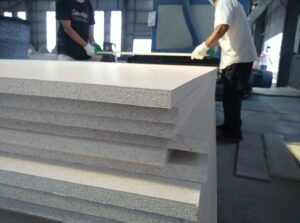
- Water absorption: quality MgO board absorbs about 0.34% surface moisture versus roughly 3% for gypsum drywall; fully submerged for 24 hours, a standard board takes on around 20%. EN 12467 impermeability testing reports about 0.08% moisture movement.
- Mould: yes. The core is inorganic and alkaline (pH roughly 8–10), so it offers mould and mildew no organic food source. Boards tested to ASTM G21 typically score 0/0/0 (no fungal growth).
- The catch — binder type: chloride-based (MgCl₂) boards can “weep” salty droplets once relative humidity exceeds about 80–84%, corroding fasteners and framing and eventually supporting mould. Sulfate-based (MgSO₄) boards absorb markedly less moisture and are the correct choice for humid, coastal or wet-area applications.
- Installation still matters: seal cut edges and joints, use stainless or coated fasteners, and apply a waterproof membrane in showers and other continuously wet zones. The board is a stable substrate, not a substitute for a waterproofing layer.
20
NOV
2026
NOV
2026
0