
In a flat roofing system, MgO (Magnesium Oxide) boards act as a high-performance structural substrate or cover board. They are increasingly replacing traditional OSB (Oriented Strand Board), plywood, or gypsum-based boards due to their superior fire rating and moisture resistance.
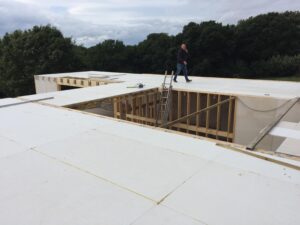
Here is the technical breakdown of using MgO boards for flat roofing:
- The Core Functional Role
In a flat roof assembly, the MgO board is typically installed over the metal or wood framing to provide a solid, flat surface for the waterproof membrane.
- A1 Fire Rating: Essential for commercial projects with strict fire codes. It acts as a fire barrier between the building interior and the external roofing membrane.
- Compression Strength: It provides a rigid base that protects the insulation layer from being crushed by foot traffic during maintenance.
- Dimensional Stability: Unlike wood-based sheets, MgO boards exhibit minimal expansion or contraction (low linear thermal expansion), which prevents the waterproof membrane from tearing at the joints.
- Critical Specification: Sulfate-based vs. Chloride-based
For flat roofing, Sulfate-bonded MgO boards (Magnesium Sulfate) are the industry standard for high-end or industrial projects.
- The Corrosion Risk: Standard “Chloride” MgO boards can “sweat” (release salty moisture) in high-humidity roof cavities. This moisture is highly corrosive to the metal screws (fasteners), steel joists, and aluminized steel frames typically found in flat roof assemblies.
- The Sulfate Advantage: Sulfate boards are “chloride-free,” meaning they will not cause the fasteners to rust or the structural steel to corrode over time.
- Common Technical Specifications
| Feature | Typical Requirement for Flat Roofs |
| Common Thickness | 12mm, 15mm, or 18mm (depending on span and load) |
| Edge Profile | Square Edge (for standard layouts) or Tongue & Groove (T&G) (to prevent vertical displacement between boards) |
| Density | High Density (> 1,000 kg/m³) is preferred for structural strength |
| Flexural Strength | Must meet local building codes for roof loading (wind uplift and live load) |
7
MAY
2026
MAY
2026
0